Bamboo, aluminium and the other decks people ask about
Strand-woven bamboo, aluminium boards, porcelain on pedestals and recycled plastic all turn up in Australian quotes. What they actually are, where they fail, and the warranty clauses that matter.
By Custom Decking editorialUpdated 18 October 2025
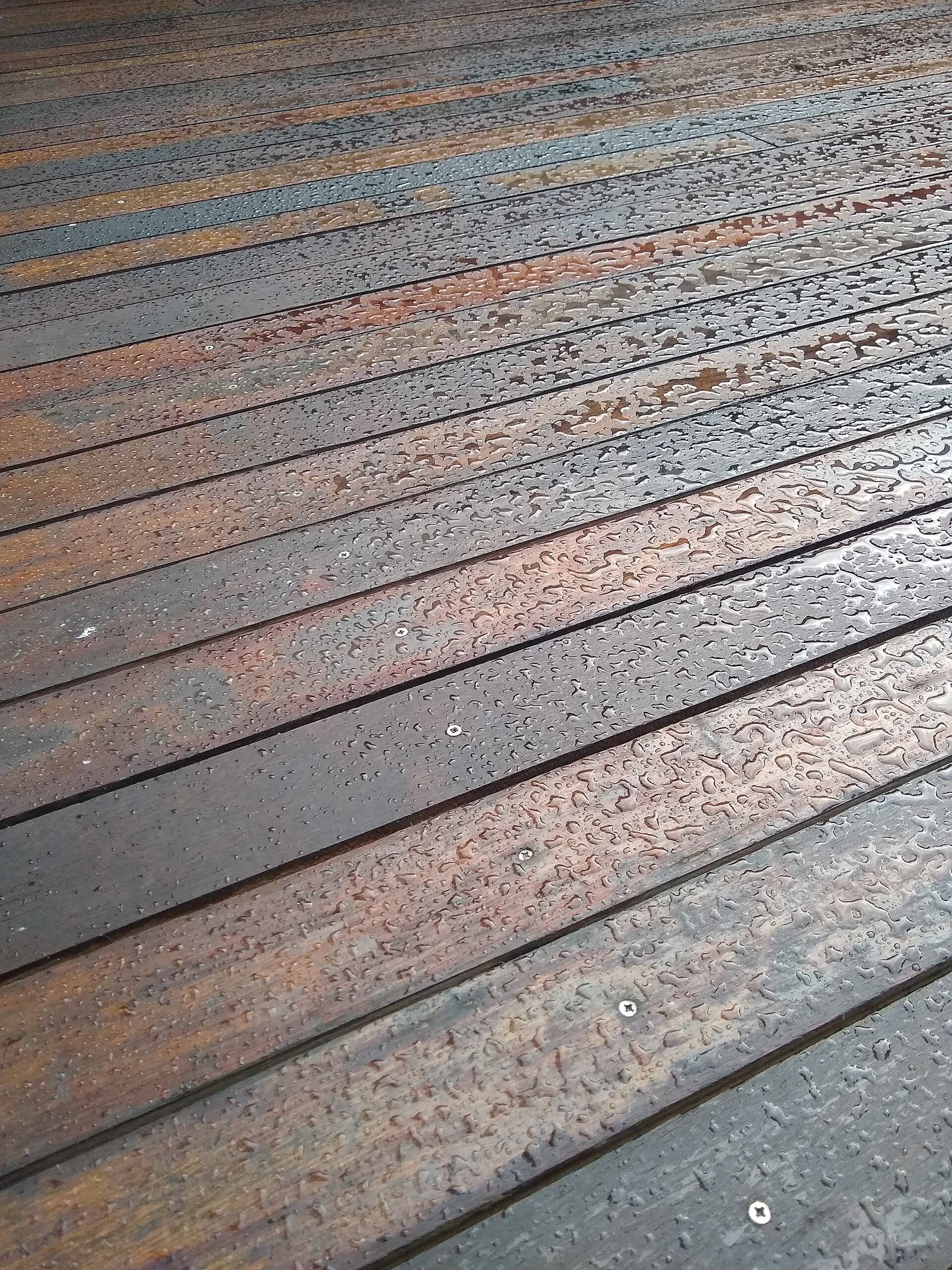
Not every quote that reaches this desk is spotted gum or a capped composite. Households ask about strand-woven bamboo because the marketing is green and the sample is hard. They ask about aluminium because a neighbour in BAL-29 country just installed it. They ask about porcelain tiles on adjustable pedestals because the architect has a roof terrace to drain. They ask about 100 per cent recycled plastic because a hardware catalogue used the word circular. All of these can be real floors. None of them is a hardwood deck with a different label, and the warranty booklet is usually where that becomes clear.
This essay sits with the other materials pieces. It assumes you have already read composite versus timber — wood–plastic is the common alternative, and it is not repeated here at length — and that you can still find choosing decking boards and fasteners when the conversation returns to gaps and clips. For a terrace over a room, start with waterproofing decks over living spaces and treat the wearing surface as the last decision.
Strand-woven bamboo
Bamboo is a grass. Outdoor “bamboo decking” is not a culm laid on joists. It is almost always strand-woven: crushed fibre, soaked in a resin, pressed into a dense block, then machined into a board that can be grooved for clips. The hardness can exceed many eucalypts. The look is a tight, linear grain that people either want or find relentless. The colour is whatever the factory stained or left.
The resin and the press are the product. A board made for interiors — kitchen flooring in a climate-controlled box — is not an exterior board, even if a merchant is happy to sell it as one. Exterior products have a different adhesive story, a different density target, and a finishing system aimed at ultraviolet light and rain. If the data sheet does not say exterior, it is not exterior.
Moisture is the Australian test. Strand-woven boards can be dimensionally impressive in a laboratory and still swell, cup or open at the end in a wet-and-dry cycle they were not designed for. Tropical Queensland, a permanently damp south court in the southern capitals, and a deck that never dries under a leaking planter are the jobs that generate the unhappy letters. A covered verandah in a dry climate is a kinder brief. Tropical wet-and-dry is the climate that most often writes the unhappy letter; this paragraph is the materials warning.
Ultraviolet light greys and can chalk a factory finish. You are back in a maintenance cycle, just not an oil-on-eucalypt cycle. Use what the manufacturer named. A random decking oil from a hardwood habit can void the document you thought you were buying.
Fire and bushfire are not a bamboo folk story. Unless the specific board has a test a certifier will accept, do not take strand-woven bamboo into a mapped BAL overlay as if it were blackbutt. AS 3959’s listed species are listed species. A resin-dense grass is something else.
Sustainability claims need a chain of custody. Bamboo grows fast. The resin does not. The press is in a factory that may be a long way from the joist. “Renewable” on a swing-tag is not a life-cycle assessment. If the green claim is why you are here, ask for the certification and the adhesive type. If the answer is a leaf logo with no standard behind it, you are buying a feeling.
Aluminium
Aluminium decking is a roll-formed or extruded board, usually powder-coated, often with a slip-resistant texture, fixed on a metal or timber substructure with a proprietary clip. It does not rot. It does not feed termites. It does not oil. It is, in the right alloy and coating, a serious coastal and bushfire material.
Non-combustible wearing surfaces change the BAL conversation. An aluminium system with a test report and a detailing manual is one of the few ways to keep a deck-like floor in country that has run out of patience with timber. Read bushfire BAL ratings and deck design first; the product is a response to that problem, not a style that happens to be allowed.
Salt is kinder to aluminium than to unprotected steel, which is why marine hardware is aluminium or 316. Coatings still chalk and scratch. A scratch that reaches the metal in a coastal yard can become a bloom. Specify the coating system, not just the colour. Fasteners should be compatible — stainless into aluminium wants the right isolation or the right grade, or you will invent a corrosion cell that the timber carpenters on site may not expect.
The costs you do not see on the swing-tag: heat on a dark powder-coat in January; glare off a light one; a hollow or drumming sound under a hard heel; a look that remains industrial even when the wood-grain film is well printed. Thermal movement on a long run is real. Expansion joints are not optional decoration. Rain on aluminium is louder than rain on hardwood. If the deck sits over a bedroom, that is not a small point.
Aluminium is honest when the brief is performance — fire, salt, zero rot, a commercial terrace that will be hosed. It is less honest as a timber substitute for a household that wanted the smell and the give of a board. You cannot oil it into warmth. You can put furniture and plants on it and live well, if you wanted a metal floor.
Porcelain tiles on pedestals
This is the system that saves roof terraces. A waterproofed slab or a membrane on a substrate, a drained cavity, adjustable plastic or composite pedestals, and a thick outdoor porcelain tile or paver that sits loose on the pedestal head. Water goes through the joints, onto the membrane, and out the overflow. The tile is not fixed through the waterproofing. That last sentence is the point.
It is the right outdoor floor over living space more often than a timber deck is. Timber over a room is a waterproofing and decay problem with a long Australian history of stained ceilings. Pedestals keep the wearing surface inspectable and the membrane unperforated if the design is competent. The waterproofing should lead. The tile is the shoes.
What you give up: the feel of timber; some acoustic softness; the ability to screw a bench down wherever you like; a cheap edge detail. Pedestal fields need a designed perimeter, a wind-uplift story on exposed roofs, and a fall in the membrane that actually finds the drain. Tiles crack if the pedestal heads are wrong or if someone drops an engine block. They also get hot, they can be slippery with algal film if the texture is too polite, and they are only as good as the membrane nobody sees.
Weight and height matter. A thick porcelain on pedestals plus the water in the cavity is a load the original slab may not have been asked about. A threshold that was meant to meet a 19 millimetre board will not meet a 150 millimetre pedestal field without a ramp or a step. A ramp or a rebuilt threshold is the companion if anyone in the house needs a level landing.
Do not call this a deck in a planning conversation if the council thinks a deck is a timber platform with a subfloor. Names trigger codes. Draw what it is.
Recycled plastic
Boards made from recycled high-density polyethylene, or mixed plastics, without a timber fibre, turn up in parks, boardwalks and the occasional household quote. They do not rot. They can take a wet site that would eat pine. They expand. They can look like a picnic table that grew up. The colour is in the plastic and still fades. The surface can be slippery when wet and dusty when dry. Fire performance is a plastic’s fire performance unless a specific product has a test.
The circular claim is only as good as the feedstock and the local end-of-life path. A board made from recycled bottles is still a polymer at the end of its second life. Australian recycling for that second life is not something you assume at the kerb. If the ethics of the material are the reason for the purchase, ask the manufacturer where the board goes after a decade of ultraviolet light. “Recyclable” and “recycled here” are different sentences.
For a household entertaining deck, recycled plastic is a specialist choice: a wet jetty, a utility walk, a council-adjacent job that wants the park language. For a custom deck off a dining room, most people who sample it want to talk about timber or porcelain next.
The warranty small print
Alternative materials live and die in the booklet. Read it as if you were the person who will be refused a claim.
Watch for exclusions that describe Australia without using the word: “coastal environments” defined as a distance from salt water that includes your street; “commercial use” that includes a holiday let; “pool and spa chemicals”; “failure to maintain” defined as a washing calendar you were not given at handover; “colour change” carved out of the fade warranty; “mould and mildew” carved out of the stain warranty; “structural” defined so that a cupped board is cosmetic.
Watch for the installation clauses. Many warranties die if the joist centres were stretched, if the wrong clip was used, if the end-gaps were closed, if the installer was not “accredited”, or if you cannot produce a receipt and a photo of the substructure. That is not unique to bamboo. It is sharper on imported systems whose only local presence is an importer and a mobile number.
Watch for the company. A twenty-five-year warranty from a brand that has been in the country for two summers is a piece of paper. A shorter warranty from a firm that still stocks matching boards is often the more valuable document. We cannot audit every importer. We can say: ask who will sell you one board in year seven.
Timber has less theatre in the warranty and more honesty in the repair. A local hardwood can be replaced from a yard. That is a form of warranty the booklet never mentions. It is also why a documented local hardwood still belongs in this conversation even when the alternative is not timber at all — supply you can touch later is a design feature.
How to compare without a swing-tag
Put the actual product on the site. Heat, glare, wet slip, the sound of a step, the look against the house paint. Ask for the data sheet, the fire or BAL report if the lot is mapped, the span table, the fastener schedule, and the warranty in English for this country. Ask the builder which of these they have lifted a failed board out of.
Then match the system to the job. Bamboo is an engineered outdoor board with a resin, for dryish, low-BAL, warranty-literate clients. Aluminium is a performance floor for fire and salt. Porcelain on pedestals is a drained terrace, especially over rooms. Recycled plastic is a wet-site utility board. Composite, already covered, is the low-oil polymer most people actually meant. Hardwood remains the default custom deck in unmapped Australia because the trade knows it and the repair path is the local mill.
If you have used one of these systems on a job and the booklet’s clauses did not match the climate, the write for us page explains how to pitch that experience. We would rather publish a correction than a hope. Ordinary factual corrections go to contact. The rules of evidence are on editorial standards.
Questions readers ask
- Is strand-woven bamboo a good outdoor deck in Australia?
- It can be, on a dry, well-detailed residential deck with a product that was actually made for exterior use. It is a poor experiment in a tropical wet season, on a constantly shaded south court, or wherever the warranty’s moisture and UV clauses would already make you nervous. Treat it as an engineered board with a resin, not as a hardwood with a story.
- When is aluminium decking the honest choice?
- When the overlay is bushfire, the air is salt, or you need a non-combustible wearing surface that will not rot. It is less honest as a cheap lookalike for timber in a garden where heat, glare and a hollow sound will annoy the household every afternoon.
- Do porcelain tiles on pedestals count as a deck?
- They count as an outdoor floor, and they are often the right floor over a waterproofed living space. They are not a timber deck and they will not behave like one. If the brief is a sprung hardwood platform among trees, pedestals are the wrong system. If the brief is a drained terrace over a rumpus, they may be the only grown-up one.
Keep reading
Related essays
Imported hardwoods versus Australian-grown timber
Merbau, keruing and the other imported boards can be honest. They can also be illegal, unstable in Australian sun, or a missed job for a local mill. How to tell the difference.
Choosing decking boards and hidden fasteners
Width, profile, gap, screw alloy and clip system decide whether a deck stays flat. A practical Australian guide to 86 and 140 boards, reeded faces, stainless against coated screws, and end-sealing.
Treated pine decks: when they make sense, and when they do not
Treated pine is the default Australian deck frame and a questionable wearing surface. H3 against H4, the CCA story, copper azole, paint, expected life and the bushfire limits that end the argument.