Imported hardwoods versus Australian-grown timber
Merbau, keruing and the other imported boards can be honest. They can also be illegal, unstable in Australian sun, or a missed job for a local mill. How to tell the difference.
By Custom Decking editorialUpdated 8 November 2025
Australian decks are built from Australian trees and from trees that grew a long way from the joist. Both can be good timber. Only one of those sentences is always true in the marketing. This essay is about the other sentence: when an import is a documented product with a reason to be on the house, and when it is a price, a colour and a shrug.
It belongs in timber and materials next to the species guide, Australian hardwoods for decks, which treats merbau as a wearing surface. Here merbau is a legality and a supply-chain problem that happens to look like decking. Treated pine is the other volume timber in the frame, and it is domestic plantation softwood — a different politics, a different hazard class, not an import argument.
What is actually coming in
The imported board most Australians meet is merbau: Intsia species from Indonesia, Malaysia, Papua New Guinea and a scatter of other Pacific and South-East Asian sources. It is stable for a tropical hardwood, rich brown, classy on a brochure, and famous for the rust-coloured extractive that stains pale paving in the first storms.
Other names turn up. Keruing and related dipterocarps appear as cheaper, oilier boards, sometimes as a substitute that was not named on the first quote. Bangkirai, ipe, cumaru and other dense tropical hardwoods appear on architect-led jobs and on internet orders. Some of these are excellent outdoor timbers in their home climates. Some move, check or fade in Australian ultraviolet light in ways the importer did not print. Some are just merbau with a more expensive story.
Plantation softwoods also cross the water — structural pine, some dressed products — but the household argument is almost always the brown board on top. The frame is still, in most suburbs, Australian-grown treated pine.
A species name is not a source. Merbau from a certified concession is not merbau of unknown origin on a cash invoice. Spotted gum from a New South Wales mill is not “spotted gum” that a merchant cannot place on a map. Ask for the forest, the mill and the certificate. If the answer is a wave at the container, you already have the answer.
The law, which is not a vibe
Australia regulates illegal logging through the Illegal Logging Prohibition Act 2012 and its rules. Importers of regulated timber products, and processors of raw logs, must have a due-diligence system: know the product, assess the risk that it was illegally harvested or traded, and mitigate that risk. The Act is about legality in the country of harvest, not about whether you like the colour.
That does not make every merbau board on a suburban truck illegal. It makes an undocumented cheap parcel a problem for the person who imported it — and a reputational and, in some contracts, a specification problem for everyone downstream. Builders and owners are not all importers. They are still the people who will be asked, by a council, a green-rating assessor or a neighbour who reads, where the deck came from.
Certification is the practical language of that due diligence. FSC and PEFC are the schemes you can actually verify. A stamp, a chain-of-custody code, and a merchant who will put the certificate on the quote are the minimum. A leaf-shaped logo invented by a marketing department is not a scheme. Neither is “the yard has been here thirty years”. Longevity is not a chain of custody.
CITES listings change, and a species that is fine this year can be restricted next year. We will not freeze a list in an essay that should still be readable later. We will say: if the species is famous for pressure — merbau has been, repeatedly — the file should be thicker, not thinner.
Domestic hardwood is not automatically innocent. Native-forest harvest in Australia is a regulated, argued, state-by-state activity. Plantation eucalypt and the certified native parcel are the specifications that survive a conversation with someone who cares about forests. “Australian” is a geography. It is not a certificate. Ask local mills the same question you ask importers: where, and under what rule.
Carbon, said without a fake number
A board that grew in New South Wales and dried in New South Wales travelled less than a board that grew in Kalimantan, moved through a mill, a port, a ship and a distribution shed in an outer suburb. Distance is not the whole life cycle, but it is not nothing. Anyone who tells you the imported board is “carbon neutral” because trees absorb carbon is skipping the diesel, the resin if any, the drying, and the fact that a short-lived deck is a short-lived store.
Anyone who tells you the local board is automatically the lowest-carbon choice without talking about the forest, the dryer and the expected life is skipping too. A local board that fails in eight years because it was the wrong class or the wrong detail is a worse store than a documented import that stays on the joists for twenty-five. Life of the product is part of the carbon story. That is one reason this journal will not invent a kilogram figure for “a square metre of deck”. Boundaries move. Brochures do not admit that.
What we will stand behind: prefer a documented species that is durable enough for the exposure, from the shortest honest supply chain that can deliver it, and then detail it so it lasts. That sentence favours Australian hardwoods for most east-coast custom decks. It leaves room for an import that is certified, stable and fit, when the local mill cannot meet the brief.
If end-of-life matters, timber that a future carpenter can reuse beats a polymer mix. That comparison sits next to any polymer wearing surface. Among timbers, a species the next owner can match at a local yard is a quieter form of conservation than a one-off tropical board that will never be stocked again.
Movement in Australian sun
Tropical hardwoods did not grow in a Melbourne westerly or a Canberra frost. Some, merbau among them, are relatively stable and have a long Australian track record as decking — extractive bleed and all. Others were selected for colour and price. In a hard ultraviolet climate they check, they go grey in blotches, they move more than the clip system wanted, or they arrive at a moisture content that made sense in a humid warehouse and does not make sense on a dry slab in February.
Acclimatise every imported parcel on site. Do not treat a container-fresh board as ready. Measure moisture if the job is large. Set the gaps and fasteners for the timber you have, not for the last spotted-gum job. End-seal. Expect bleed on merbau and plan the paving accordingly.
Australian eucalypts move too. The difference is that the local trade has a century of verandahs to look at. The movement is priced in. An unfamiliar import is a first deck every time unless the carpenter has laid that species in this climate. If they have not, the cheap metre becomes an education you will pay for.
Bushfire listings are species-specific. Some imports, merbau included, appear in AS 3959’s bushfire-resisting timber list. That is a technical fact, not a moral one. It is also not a reason to take an undocumented merbau onto a BAL-29 lot and call it compliance. The certifier wants the species and the detailing. The Act still wants the file. AS 3959 is not a substitute for either.
Supporting local mills
A custom deck is one of the last ordinary ways a household buys a visible parcel of Australian hardwood. The joists may be pine. The boards can still be a mill in northern New South Wales, a Western Australian jarrah parcel, or a Tasmanian specialist if the brief is unusual. That purchase keeps drying kilns, graders and the habit of stocking 86 and 140 millimetre decking in a yard you can drive to when a branch comes down in year six.
It is not automatically cheaper. Spotted gum and blackbutt have been expensive, and they have been scarce after fires and wet years. An import that undercuts them by a couple of dollars a metre is doing a simple job: taking the order. If the household’s only brief is price, the import will often win, and we should not pretend otherwise. If the brief includes repairability, a known movement, a local worker who knows the grain, and a forest that is on the same regulatory books as the house, the local board is the specification.
“Support local” is not a reason to take a poor grade. A twisted, sapwood-heavy domestic parcel is not a moral victory. Reject it and ask again. Mills that want the custom-deck market have to supply decking grade, dry enough, on time. Households that want those mills to exist have to write the species on the quote and wait a fortnight instead of taking the container that is already on the forklift.
Pine is local in a different way. Plantation softwood is an Australian rural industry. Using it as a frame under a hardwood wearing surface is already a local specification. You do not need to board the walking surface in pine to “support the industry”. You need to specify H3 and H4 correctly and stop burying the wrong class.
When an import is honest
An import is honest when three things are true at once.
First, there is a reason the local mill is not the answer: lead time that would miss a lock-up; a species characteristic you actually need — merbau’s stability on a long, straight run, a listed fire performance, a match to an existing deck the house already wears; or a volume the domestic market cannot fill this season without taking a worse grade.
Second, the parcel has a chain of custody. Certificate, species, source region, and a merchant named on the invoice who will still take a phone call when a board fails. The documents sit with the contract, next to the builder’s quote, not in a drawer at the yard.
Third, the climate detailing is written for that timber in this country: gaps, fasteners, end-sealing, bleed management, and a finish the species will take. An honest merbau deck in a pale limestone court is still a stain project. Honesty includes saying so.
An import is not honest when the only reason is that it was on special; when the name on the quote is “hardwood” or “kwila” and no one can pin the forest; when the carpenter has never laid it and the moisture content was not discussed; when the BAL report and the due-diligence file are both imaginary. Cheap brown boards have a place in the market. That place is not a custom deck on a house you mean to keep, and it is not this journal’s recommendation.
For termites, do not assume a dense import is a management system. Density is not AS 3660. The termite essay still applies. For the rest of the house — shade, living, the reason the deck exists — the outdoor living and design hubs are the next reading, not another species argument.
Specifying so the next owner can tell
Write the species, the source, the certificate number if any, and whether the timber is Australian-grown or imported. Write it on the drawings if the job has drawings. Future you, a future buyer, and a future carpenter replacing a bay after a fallen limb should not have to guess. Mystery timber becomes mixed parcels at the first repair. Mixed parcels look like a mistake.
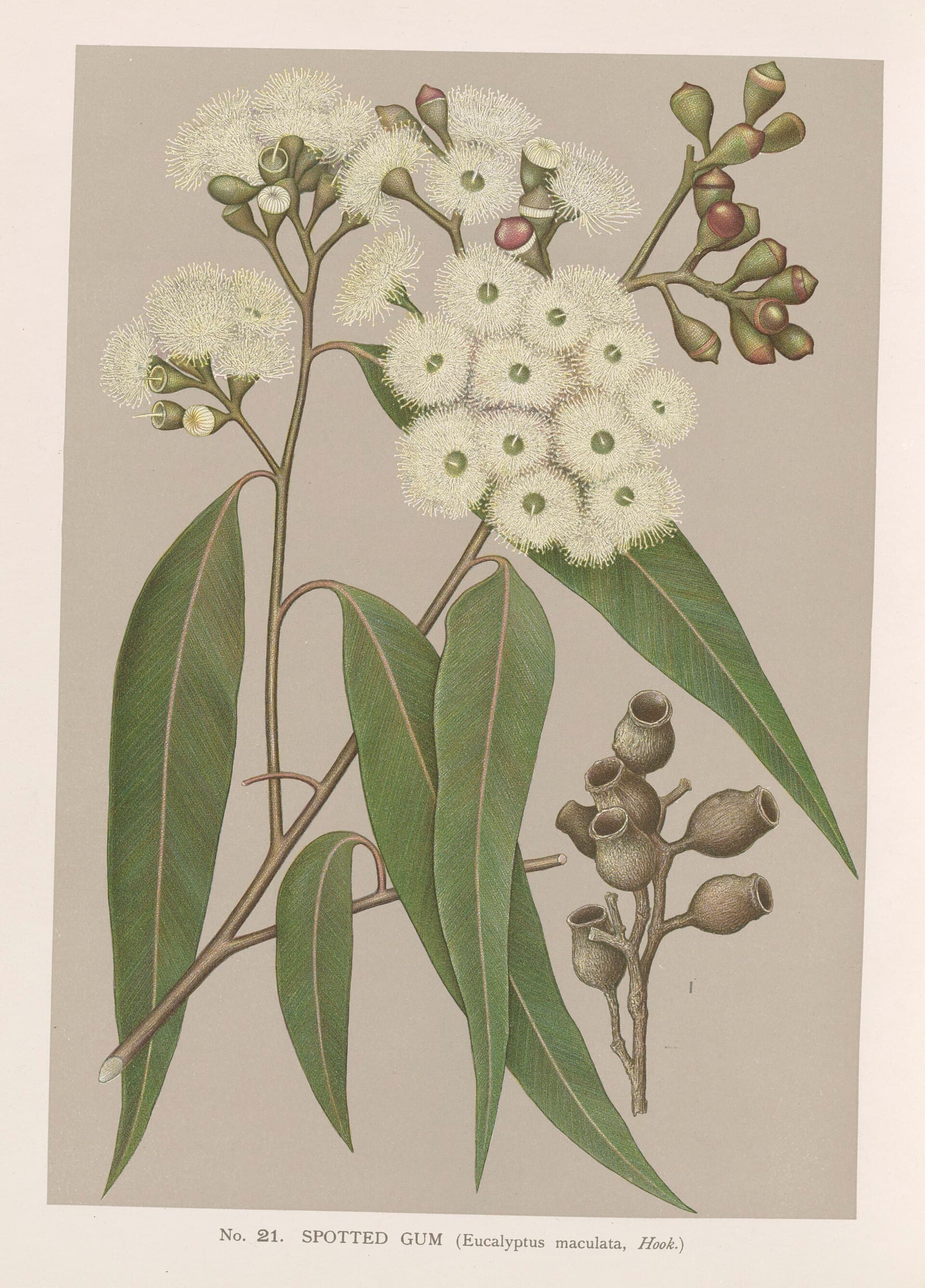
Australian-grown hardwood is still the default wearing surface this publication would put on most unmapped custom decks: spotted gum, blackbutt, the western jarrah story, tallowwood and ironbark when the job wants them. Imports can join that list when they are lawful, certified and chosen for a reason that will still make sense when the stain has been washed off the concrete. The botanical plate on this page is a spotted gum, credited on image credits, because that is the tree the east-coast trade can actually name.
If you have documents that change a legality or certification point in this piece, send them to contact. We will correct against the Act and the scheme rules. The about page explains why this journal treats a chain of custody as a building detail. The standards we edit to are on editorial standards.
Questions readers ask
- Is merbau illegal in Australia?
- Merbau as a species is not banned. What is banned is timber that was illegally harvested or traded. Australia’s Illegal Logging Prohibition Act requires importers and processors to have a due-diligence system. A cheap merbau deck with no paperwork is the risk. A certified parcel with a file you can read is a different product.
- Does buying Australian-grown timber always mean a lower carbon footprint?
- Not always, and anyone who gives you a single number without a boundary is selling. Transport is shorter on a domestic eucalypt, which matters, but forestry practice, drying energy and the life of the deck matter too. A documented local board that lasts is usually the cleaner story than a mystery container. It is not a licence to ignore how the local forest was managed.
- When is an imported decking timber the honest specification?
- When the species does a job Australian mills cannot meet on time or on grade — a particular stability, a tested fire result, a colour the house already has — and the parcel has a chain of custody you can show a sceptical neighbour. Honesty is the documents plus a reason, not the price.
Keep reading
Related essays
Bamboo, aluminium and the other decks people ask about
Strand-woven bamboo, aluminium boards, porcelain on pedestals and recycled plastic all turn up in Australian quotes. What they actually are, where they fail, and the warranty clauses that matter.
Choosing decking boards and hidden fasteners
Width, profile, gap, screw alloy and clip system decide whether a deck stays flat. A practical Australian guide to 86 and 140 boards, reeded faces, stainless against coated screws, and end-sealing.
Treated pine decks: when they make sense, and when they do not
Treated pine is the default Australian deck frame and a questionable wearing surface. H3 against H4, the CCA story, copper azole, paint, expected life and the bushfire limits that end the argument.