Treated pine decks: when they make sense, and when they do not
Treated pine is the default Australian deck frame and a questionable wearing surface. H3 against H4, the CCA story, copper azole, paint, expected life and the bushfire limits that end the argument.
By Custom Decking editorialUpdated 2 October 2025
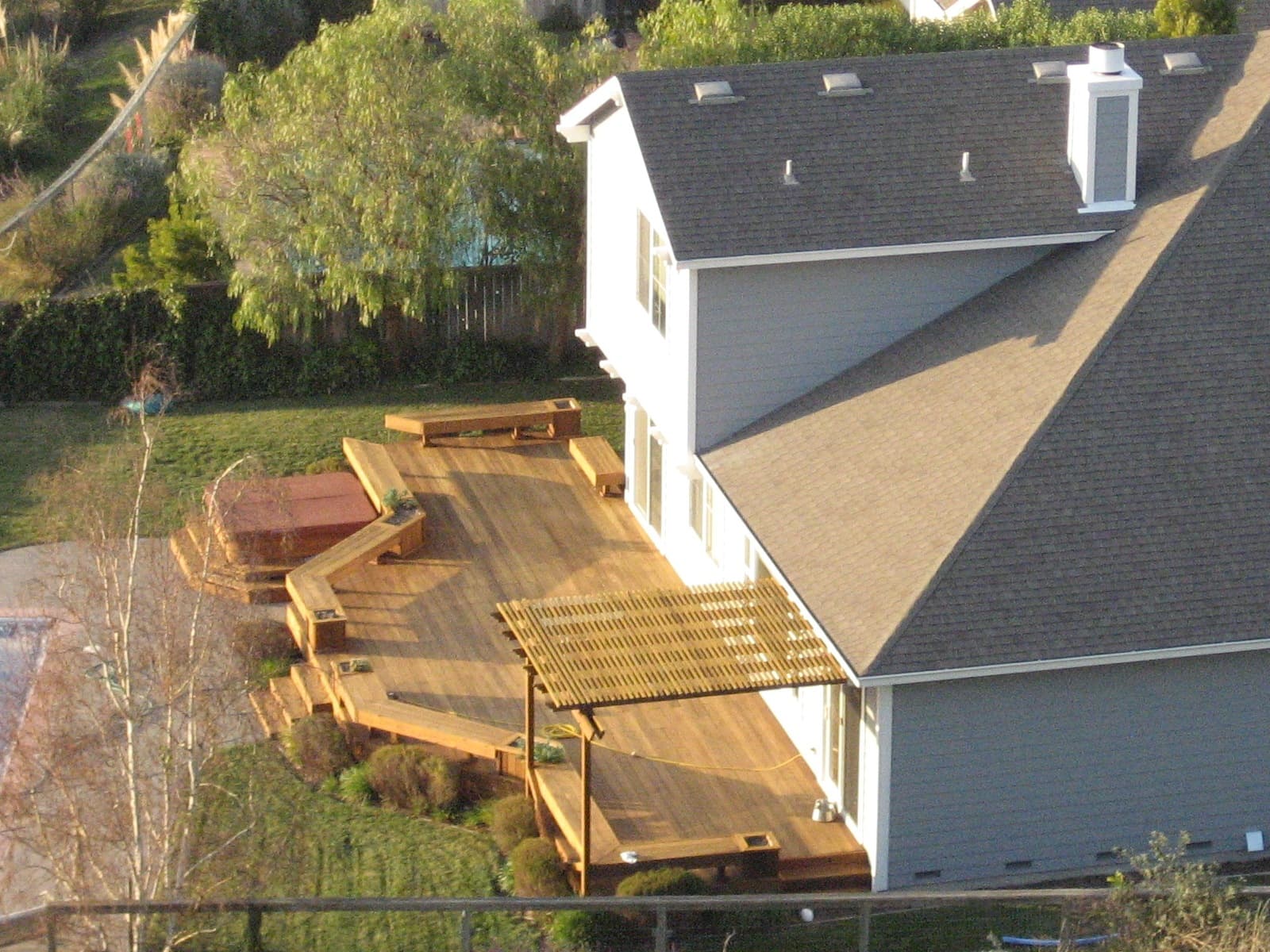
Treated pine is how most Australian decks stand up. It is also how a lot of them look tired in year eight. Those two facts are not a contradiction. Hazard-class pine is a structural material with a known chemistry, a known fastener problem, and a wearing surface that only makes sense in some briefs. The mistake is to treat “pine deck” as one product. The frame and the boards are different jobs, and they fail on different calendars.
This piece belongs with the rest of the timber and materials desk. For the hardwood alternative on top of a pine frame, read Australian hardwoods for decks. For the holes in the ground that the pine posts sit in, see footings, stumps and posts. Termites do not care that the pine was treated if the rest of the house is a free meal; that is termites and deck construction.
What the H numbers mean
Australian preservative treatment is specified through AS 1604. The H classes are hazard classes, not marketing grades.
H3 is above-ground, exposed to weather, not in ground contact. That is a decking board, a handrail that stays dry at the base, a joist that is out of the dirt and able to dry. H3 is the class you see on most pine decking and on a lot of the framing in a raised deck.
H4 is in-ground or in fresh-water ground contact, with a severe decay hazard. That is a post in soil, a sleeper holding a garden edge, a bearer that will sit in a damp pocket you cannot honestly call “above ground”. H5 and H6 exist for more severe and marine situations and are not the usual household deck conversation.
The stamp on the end of the board is the document. A green colour is not a class. Copper-based treatments leave a green or olive cast that fades; solvent-borne treatments can look almost untreated. If the stamp is missing, assume nothing. If the stamp says H3 and the carpenter is burying the end, stop the job.
LOSP — light organic solvent preservative — is a different pathway, often used on dressed, painted pine because it does not leave the same wet, green look. LOSP H3 is still H3. It is not an in-ground ticket, and the solvent carrier means you wait for the timber to be fit to coat. People who paint a wet LOSP post on a Friday and wonder why the film fails in spring are not unlucky. They were early.
CCA, and what replaced it on the rack
Copper chrome arsenate treated a generation of Australian pine. It worked. It also put arsenic and chromium into a product that households cut, sanded and let children crawl on. The Australian Pesticides and Veterinary Medicines Authority restricted CCA for a set of domestic uses in the mid-2000s. Playground equipment, picnic tables, and the sort of domestic decking and handrails people contact were in that conversation. CCA did not vanish from the country. It receded from the household touching surface.
What you buy now for a backyard deck is usually a copper azole or similar copper-based system, sometimes still discussed alongside ACQ in older trade shorthand. The timber is still pine. The fungicide and insecticide are still there. The colour is still green until the weather takes it. The fastener problem is still chemistry: copper-rich timber and the wrong steel make rust, staining and, eventually, a loose board.
If you are demolishing an old pine deck, treat the dust as a contact problem. Do not burn CCA timber in a fire pit. Do not turn it into garden mulch. Your council’s timber-waste rules are the document, not a weekend instinct. New copper-azole offcuts are a milder conversation and still not kindling.
Above-ground versus in-ground
A pine deck that lasts is a deck that keeps H3 timber in the air and H4 timber, or steel, or concrete, in the ground. The junction is where people cheat. A post in a stirrup, clear of soil and able to dry, can be H3 if the detailing is real. A post dropped in a hole, backfilled, and called a stirrup because there is a bit of galvanised strap at the top, is an H4 job that was quoted as H3.
Bearers and joists want air. Close to a damp masonry wall, close to a garden bed that gets heaped against the frame, close to a sloped site where splash never stops — those are decay conditions. Treatment buys time. It does not repeal wet pine in a closed pocket. The structure hub exists because this detailing is the building, not the finish.
On-ground or near-ground pine decks in a wet climate are the jobs that turn people against the material. The boards stay wet on the underside, the joists never dry, and the treatment is asked to do work that drainage should have done. Raise it, ventilate it, or choose a different system.
Framing versus wearing surface
This is the distinction that should be on every quote.
As framing, treated pine makes sense across most of the country. It is available, it is cheap relative to hardwood framing, it is graded, and AS 1684 knows how to span it. A spotted-gum wearing surface on an H3 pine joist field is an ordinary, respectable Australian deck. The pine is in the shade of the boards. It is not the thing people walk on. It will outlast the oil on the hardwood if the ventilation is right.
As a wearing surface, treated pine is a budget choice with a shorter cosmetic life. The boards are softer. Chair legs mark them. A dropped tool bruises them. In sun they check and raised grain appears if the finish dies. In shade they grow mould faster than a dense hardwood. Splinters are a real complaint, especially on a cheap, wide, face-fixed board that has been allowed to cup.
Pine decking still has honest jobs: a low platform in a rental; a first deck a household will replace when they can afford hardwood; a painted verandah in the Victorian manner, where the film is the wearing surface and the pine is the substrate; a covered area that never really weathers. It is a poor choice as the long, west-facing entertaining deck of a house the owners mean to keep, unless they like painting or they like the look of tired pine.
Thickness matters. A thin dressed pine board on optimistic joist centres will bounce and cup. Check the span against the grade and the profile, not against the last hardwood job. AS 1684 and the grade stamp are the companion documents.
Painting, coating and the finish pine will accept
Pine takes paint better than most eucalypts take paint. That is one of its virtues. A painted pine deck — porch grey, a deep green, a cream that matches the weatherboards — is a historical Australian surface. It is also a maintenance surface. You are buying a recoating cycle, not a timber colour.
The timber must be dry enough to coat. New copper-treated pine is often too wet. LOSP needs its solvent to leave. Primer on the end grain, primer on the back if you are being thorough, and a paint system the manufacturer will stand behind on a horizontal outdoor surface. Floor-grade acrylics exist. Wall paint does not become floor paint because you ran out.
Penetrating decking oil on pine is possible and less durable than the same oil on spotted gum. Pine drinks, then weathers, then looks thirsty sooner. If the brief is “oil and forget”, pine boards will disappoint. If the brief is “paint and keep painting”, pine is the more rational substrate.
Do not stain pine to “look like merbau” and expect anyone who has seen merbau to believe it. The grain is pine. The hardness is pine. The story is pine. A transparent stain that accepts the species is finer than a theatrical one.
Expected life, said carefully
We will not print a fake year count. Decay rate depends on climate, detailing, the actual retention of preservative, and whether the timber stays wet. What experience and the hazard classes support is a split life.
The H4 post, properly seated in a footing that keeps a dry collar or a clean concrete haunch, is a long-term member in most soils. The H3 joist, ventilated and out of garden mulch, is a long-term member under a deck that drains. The H3 wearing board in full weather is a consumable. In a mild, maintained situation it can look acceptable for well over a decade. In a harsh western sun with no finish it can look like a mistake in five summers. Tropical wet-and-dry cycles are harder again, which is a climate problem as much as a hazard-class one.
Replacement of pine boards is cheap in materials and annoying in labour. If you know you will recut the wearing surface once, design the fastener so you can. Hidden systems on pine are less common than on hardwood and composite; face screws, stainless or a coating rated for copper-treated timber, remain ordinary practice.
Bushfire limits
Treated pine is not a bushfire-resisting timber in the AS 3959 Appendix F sense. That sentence ends a lot of arguments. In BAL-LOW and often in BAL-12.5, a pine deck may still be possible with the rest of the detailing right. As the BAL rises, the wearing surface and then the substructure are pushed toward listed hardwoods, non-combustible materials, or specific tested systems. A green pine board is not a test report.
If the lot is mapped, read bushfire BAL ratings and deck design before you price pine as the finish. A pine frame under a BAL-compliant wearing surface can still be a conversation with the certifier — sometimes yes with sarking and gaps, sometimes no. Do not let a merchant in an unmapped suburb write that specification.
Embers collect in the gaps of any deck. Pine gaps with debris in them are a poorer place for embers than a non-combustible surface. Keep the subfloor clean. That is maintenance, and it is also fire hygiene.
Fasteners, copper and the green stain
Copper-treated pine and ordinary bright steel are not friends. The copper accelerates corrosion. The rust then stains the board a dark ink that people blame on “the treatment leaking”. Use fasteners rated for the treatment: hot-dip galvanised in the right class for inland, stainless where the exposure or the client’s patience warrants it, and the coated screws the treatment manufacturers have actually tested. A mixed tub of leftover screws is how a new pine deck looks ten years old in eighteen months.
The same chemistry applies to joist hangers, stirrups and concealed clips. Ask. 304 against 316, and which clip you can actually buy in stainless, is a fastener conversation. The pine-specific point is that the timber itself is part of the corrosion cell.
Cut ends of treated pine expose untreated core. Brush-on end preservative exists for that reason. Use it on every cut, especially a post top that will sit in weather. The stamp was on the end you cut off.
Termites, children and the rest of the brief
Treatment includes an insecticide, but a treated pine deck is not a termite management system for the house. The NCC still wants a system in termite-capable zones, which is most of the mainland. A treated post can be chewed around, and untreated house framing can be reached through a lazy junction. Termite construction detailing is not optional reading because the pine is green.
For households with small children, the old CCA anxiety is the reason the chemistry changed. Current copper systems are the ordinary domestic product. Do not sand them inside a closed room. Do not let a toddler mouth a freshly cut offcut. That is ordinary hygiene, not a reason to avoid the material as framing.
When pine makes sense, and when it does not
Pine makes sense as the frame of a custom deck in almost every unmapped or low-BAL suburban job, and as the whole deck when the budget, the paint cycle, or the temporary nature of the platform is honest. It makes sense under a hardwood wearing surface. It makes sense on a covered verandah that will be painted with the house.
It does not make sense as a long-life, bare-oil wearing surface in harsh sun for a household that wants to stop thinking about the deck. It does not make sense in the ground at H3. It does not make sense as a BAL-29 shortcut. It does not make sense when the quote has used pine boards to cheapen a job that was sold as a hardwood deck.
Write the hazard class, the treatment type, the grade, the member sizes and the fastener on the contract. Write whether the pine is frame only or frame and finish. Then decide whether you are buying a structure or a look. Treated pine is an excellent structure. It is a conditional look. The design hub is where the look should have been decided; this essay is here so the material is not asked to be something else.
If a treatment label, a restriction or a BAL clause in this piece is out of date, send the current document to the desk. We correct against APVMA notices and the NCC, not against a yard rumour. How we handle that is on editorial standards.
Questions readers ask
- Can I use H3 treated pine for deck posts in the ground?
- No. H3 is an above-ground hazard class. Posts, stumps and any timber in ground contact, or in fresh fill that behaves like ground contact, want H4 or a non-timber footing. Using H3 in the ground is how a cheap quote becomes a restump in a few wet years.
- Is CCA-treated pine still legal for a home deck?
- CCA is restricted for several domestic contact uses in Australia, including a lot of the decking, handrails and playground-type surfaces people actually touch. Structural and some agricultural uses remain. For a household deck, the ordinary product on the rack is now a copper-based treatment such as copper azole. Ask what is in the timber before you cut it.
- How long will a treated pine deck last?
- The frame, kept dry, ventilated and off the soil, can last decades. The pine wearing surface in full sun and weather is the shorter part of the job — often a decade-plus if it is oiled or painted and detailed to drain, and less if it is a thin board, face-fixed with the wrong screw, and left raw on a western elevation. Treat those as two different lives.
Keep reading
Related essays
Imported hardwoods versus Australian-grown timber
Merbau, keruing and the other imported boards can be honest. They can also be illegal, unstable in Australian sun, or a missed job for a local mill. How to tell the difference.
Bamboo, aluminium and the other decks people ask about
Strand-woven bamboo, aluminium boards, porcelain on pedestals and recycled plastic all turn up in Australian quotes. What they actually are, where they fail, and the warranty clauses that matter.
Choosing decking boards and hidden fasteners
Width, profile, gap, screw alloy and clip system decide whether a deck stays flat. A practical Australian guide to 86 and 140 boards, reeded faces, stainless against coated screws, and end-sealing.