Restain, recoat or replace: deciding the next life of a deck
A tired Australian deck is three different jobs — a new stain, a new film, or new boards. How to tell which one you are actually in, and when the frame is the problem.
By Custom Decking editorial
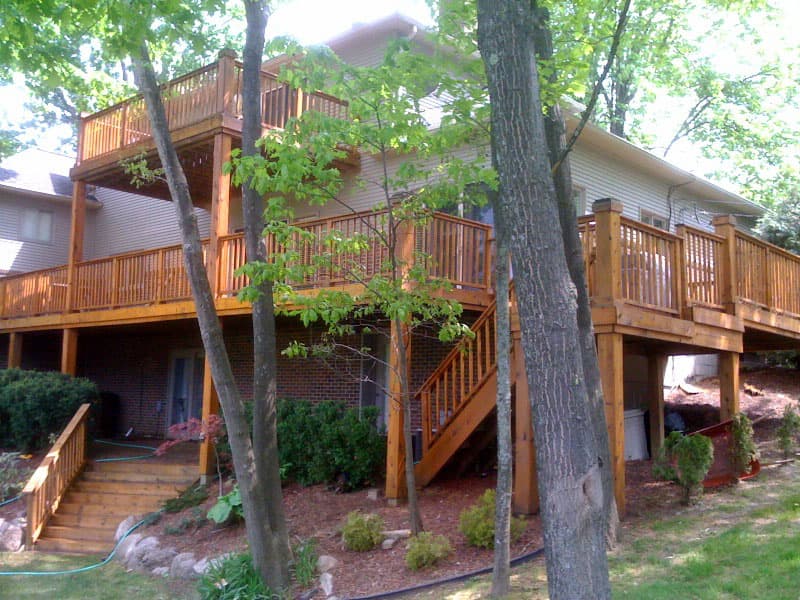
Every deck that is still standing will, at some point, look like a decision. The oil has gone patchy. The paint has let go on the western boards. A row has cupped. The household asks whether to “do the deck” this spring, and three different jobs hide in that sentence. Restain a timber that still has thickness and soundness. Recoat a film that is still a film. Replace the boards — or the boards and the frame — when finish is no longer the honest verb. Getting that diagnosis wrong is how a household spends a long weekend on a coat that fails in the first heat, or sands a board that should have gone to the tip.
This is a climate and care problem because weather is what forced the decision. The materials under the coat still matter: Australian hardwoods, treated pine, and composite each fail on a different calendar. The maintenance coat you wish you had kept up is in oiling and maintaining a timber deck.
Three different jobs
Restaining, in the sense this desk uses the word, is putting colour and oil back into timber that is still there. The grain is open. The board is hard. You may be moving from a clear oil to a lightly pigmented one, or resetting a grey face toward the honey the household remembers. You are not building a skin.
Recoating is maintaining or replacing a film: porch paint on pine, a covering stain that sits on top, a failed polyurethane someone should not have used. You are either adding to a sound film or you are taking a broken film off so the next one can hold.
Replacing is new wearing surface, and sometimes new joists, because the timber has moved past finish. Cupping that holds water, splits that take a heel, thickness lost to a generation of sanding, decay at the end-grain, a fastener that turns — those are not a darker tint.
Walk the deck before you buy a tin. Water test. Screwdriver test on anything that looks tired. Look at the underside. Look at the joists. Look at the ledger against the house. A beautiful new oil on a rotten frame is a redecoration of a problem.
What you can still save
A hardwood deck that has silvered evenly, with open gaps, sound edges and fasteners that still bite, can be left or it can be restored. Leaving it is legitimate. Restoring it means cleaning, often a brightener if tannin and rust have marked a pale species, a light sand if the face is furry, and a penetrating system the timber will actually take. That is work. It is not mystery.
A hardwood deck that is blotchy — table marks, the strip under the awning, the pot rings, a failed previous coat in islands — can usually be evened if you treat the whole plane. Spot-oiling the ugly bit writes the ugly bit in a new colour.
A pine wearing surface that is still thick enough, still fastened, and not a field of splinters can be cleaned and oiled, or cleaned and painted, depending on the brief. Pine that has cupped into a washboard, or that was a thin board on optimistic centres, is a candidate for replacement. You will spend the restoration money and still have pine manners.
Composite does not restain in the timber sense. A tired cap is washed, sometimes with a product the warranty allows, and then lived with, or the board is replaced. Do not oil a polymer cap. Do not paint it unless the manufacturer wrote that sentence and you like living with paint on plastic.
Restaining a tired oil
If the history is penetrating oil, stay in penetrating oil unless you have a reason to change systems and a method for the change. Clean as if you were about to maintain: mould first, if it is there — mould, algae and slip hazards — then a dry face. Grey hardwood will not become showroom honey from a single tinted coat. It will warm. A second coat, thin, is ordinary. A theatrical “merbau” stain on silver blackbutt is a different product and a later regret when it wears on the traffic lines.
Test a bay. Inside a cupboard of offcuts is not the same as the western face in January. If the new product beads on the old and will not wet in, you still have a skin or a contaminant. Stop. Do not pile a second system on a first that has not opened.
End-grain and cut ends still want sealer. A restoration that forgets the ends repeats the checks that made the deck look old.
Sanding: only as much as the face needs. A full machine flattening of a large hardwood deck is a dust event, a thickness event, and a neighbour event. It is justified when the face is proud at every edge, when a film has to come off, or when the household has chosen a reset and understands they are consuming board. It is not justified because a video said “sand it back to new”.
Recoating a film
Painted pine verandahs are a historical Australian surface and a recoating cycle. If the film is sound — it is dull, it is adhered, it is not peeling in sheets — wash, dull, and recoat with a system meant for horizontal exterior traffic. Wall paint is not floor paint. A cheap “deck paint” that is really a thin skin will become the next peeling job.
If the film is failing, removal comes first. You cannot out-coat a peel. Scraping, sanding, and in some cases a chemical stripper the timber and the house can tolerate — this is the expensive version of “doing the deck”. Ask whether the pine underneath is worth it. Often the honest answer on a tired, thin, sun-destroyed pine wearing surface is replacement, then a new system chosen on purpose: oil, paint, or a different board.
Never paint over a penetrating oil without the preparation the paint maker describes. The oil is still in the face. The film will crawl or let go. That is chemistry, not bad luck.
A failed polyurethane on hardwood is the worst common hybrid. It peels in islands. Restoration means getting it off, then returning to oil or committing to a paint system you are willing to keep. There is no “just oil over the shiny bits”.
When the board is the problem
Replace a board that is soft, punched through, split to a point that collects water, or so cupped that it holds a channel. Replace a run that was the wrong species or the wrong moisture content and has never sat flat. Replace pine boards that have become a splinter field if the household still wants bare feet.
Hidden clip systems make a middle-board replacement a sequence. Ask how the original was installed before you price a “few boards”. Face-screwed hardwood is the repairable Australian default for this reason; choosing decking boards and fasteners is where that decision should have been written down.
Match species, profile and colour as far as a yard can. A new spotted-gum board in a ten-year silver field will read as a patch until it weathers. Oil the new board and accept a period of honesty, or restore the whole plane so the new board is not a confession. A mixed merbau-and-eucalypt repair is a worse confession. Do not let a merchant “match the colour” with an import of unknown origin. The legality file is imported versus Australian-grown timber; the practical file is that the new board will move and bleed unlike its neighbours.
Structure underneath
Finish arguments end when the frame is finished. Soft joists, a bearer in fresh fill, a post that was H3 in the ground, a ledger that has been wet against the house — those are structure jobs. Footings, stumps and posts and termites and deck construction are the reading if the screwdriver goes in, if there is mudding, or if the deck has dropped.
A replacement wearing surface on a tired pine frame can be honest if the frame is still sound and dry. It is a waste if you are screwing new hardwood into joists that will not see out the new boards. Pull a board. Look. Smell. That inspection is cheaper than a second wearing surface.
Waterproofed decks over rooms are not a stain decision. If the membrane is the problem, the boards are the lining. Stop.
Cost without a fake spreadsheet
We will not invent a dollar figure. Prices move, and a Saturday of your own labour is not an invoice. What can be said without a brochure:
A maintenance oil on a sound hardwood plane is the cheap next life, in materials and in disruption. A full restoration with sanding is a multiple of that, mostly in labour and in the time the deck is out of use. A film removal is usually worse. Board replacement, if the boards unscrew and the local yard has the profile, sits between a restoration and a rebuild. A rebuild of boards and frame is the other end of the scale, and it is the right end when the structure is the patient.
Composite replacement cost is often a proprietary clip and a discontinued colour. Ask before you assume a single board is available in five years.
Time the work for weather you can use. A restoration that starts in the build-up to a Queensland wet season, or in a Melbourne week of showers, becomes a dirty wash-off. The climate that tired the deck is the climate that will punish a rushed coat.
After the decision
If you restain, write the product and the date. Return to a beading test, not to a promise that you are “done for years”. If you recoat a film, write the system and the next window. If you replace, write the species, the fastener, the gap and how the next damaged board comes out. Specify heartwood. Specify the alloy. Specify that the new work will be oiled or that it will be left to silver — on purpose, not by neglect.
A new wearing surface is a chance to fix the missed fall, the irrigation arc, the closed subfloor, the cheap screws that stained the last plane. Do not repeat the detailing that produced the tired deck and then blame the tin.
Bushfire overlays do not relax because you are “just replacing boards”. A change of material can be a change of BAL conversation; bushfire BAL ratings and deck design is not only a new-build essay. Councils do not usually care about a like-for-like recoat. They care when the deck grows, rises, or becomes a different structure. Approvals if the next life is bigger than the last.
The next life of a deck is a diagnosis, then a verb. Restain what is still timber. Recoat what is still a film. Replace what is no longer either. Then keep the climate in the file, because it is not done with the boards. If a method here is out of date against a product or a standard, send the document to contact. How we correct is on editorial standards. The stain line on this page is credited on image credits.
Questions readers ask
- Can I stain over an old decking oil?
- Often yes, if the oil is a penetrating type, the face is clean and dull, and the new product is compatible. You cannot stain over a peeling film and call it a stain job. Wash, let the timber dry, test a bay, and read both tins. If the old coat still beads like a skin, you are in removal, not in a refresh.
- When is replacing boards cheaper than restoring them?
- When the wearing surface is thin, cupped, split at the ends, punched through, or soft — or when a restoration would mean days of grinding a failed paint off pine that was due for replacement anyway. Labour is the cost. A local hardwood board that unscrews is a Thursday job. A clipped run that has to come out as a sequence is a different invoice.
- Does a grey hardwood deck need to be restored?
- Not for durability, if the species is right and the structure drains. Silvering is weathering. Restore when the household wants the colour back, when the face is so checked and furry that it is unpleasant, or when mould has made the grey blotchy in shade. Wanting the rack colour again is a taste decision, not a structural one.
Keep reading
Related essays
Termites and deck construction in Australia
A deck is a bridge to the house if you detail it that way. How Australian termite management, inspection zones and timber choice actually meet a custom deck — without treating a species as a system.
Poolside decks: drainage, slip resistance and chemical splash
A deck beside an Australian pool is a wet edge. Drainage, grip under a wet foot, and what chlorine or salt does to timber, fasteners and finishes — before the coping photograph.
Tropical decks in Queensland: ventilation, termites and the wet season
A deck in the Queensland tropics is a wet-season structure. Ventilation, termite management, species and the dry-season oiling window matter more than a southern maintenance calendar.